
- July 23, 2026
- Posted by: digital.acutevision@gmail.com
- Category: Uncategorized
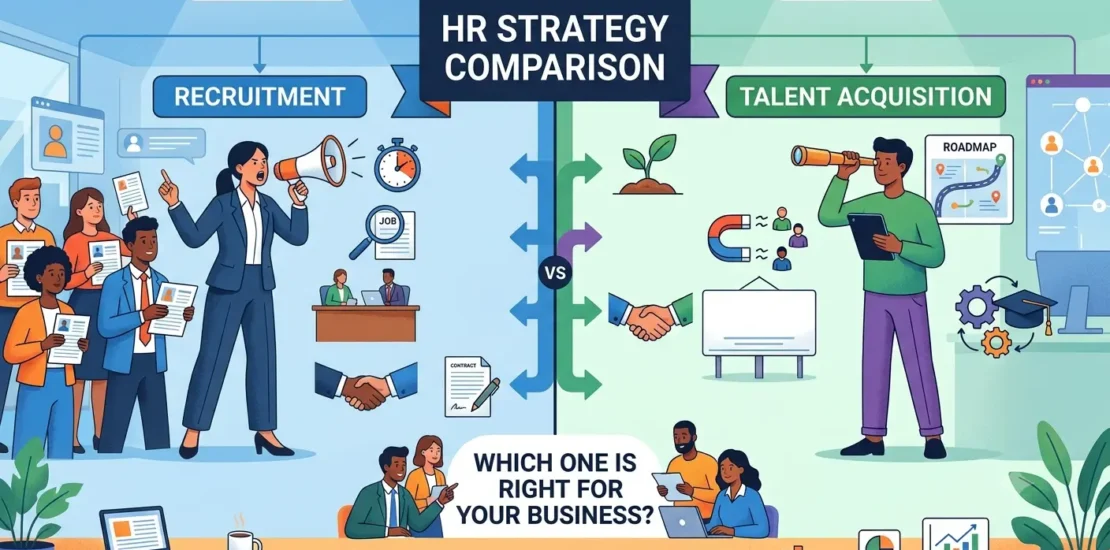
Recruitment vs Talent Acquisition: Key Differences, 7 Stages, and Roles Explained
Recruitment and talent acquisition are two important functions that help organizations find and hire the right people. Although these terms are often used interchangeably, recruitment and talent acquisition are not exactly the same. Recruitment usually focuses on filling current job vacancies, while talent acquisition takes a broader and more strategic approach to building an organization’s workforce.
Understanding the difference between recruitment and talent acquisition can help companies improve their hiring strategy, attract better candidates, reduce hiring challenges, and prepare for future workforce needs.
In this guide, we will explain the difference between recruitment and talent acquisition, discuss the seven stages of recruitment, and answer common questions such as whether talent acquisition is more important than recruitment and whether a talent acquisition specialist is the same as a recruiter.
What Is Recruitment?
Recruitment is the process of identifying, attracting, evaluating, selecting, and hiring candidates for specific job vacancies. It generally begins when an organization has an immediate hiring requirement and needs to find a suitable candidate for an open position.Companies with frequent hiring requirements often partner with Acute Vision Consultants, a trusted recruitment agency in Noida, to source qualified candidates quickly and streamline their hiring process.
The main goal of recruitment is to fill open positions efficiently with qualified candidates.
For example, if a company needs to hire a sales executive, HR recruiter, software developer, or accountant because of business expansion or employee resignation, the recruitment team will begin the hiring process to find a suitable candidate.
Recruitment is generally focused on:
- Filling current job vacancies
- Finding qualified candidates
- Reducing time to hire
- Managing applications and interviews
- Selecting suitable candidates
- Completing the hiring process
Recruitment is often more immediate and role-specific compared to talent acquisition.
What Is Talent Acquisition?
Talent acquisition is a long-term and strategic approach to identifying, attracting, engaging, and hiring talent that supports an organization’s current and future business goals. Businesses looking for a structured hiring strategy often partner with professional talent acquisition services to build strong talent pipelines and improve long-term hiring outcomes.
Unlike traditional recruitment, talent acquisition does not focus only on filling an immediate vacancy. It also considers the future workforce requirements of a company.
A talent acquisition strategy may include:
- Workforce planning
- Employer branding
- Talent sourcing
- Candidate relationship management
- Talent pipeline development
- Recruitment marketing
- Succession planning
- Internal mobility
- Diversity hiring
- Strategic hiring for specialized roles
For example, a company may know that it plans to expand into a new city within the next year. Instead of waiting until the expansion begins, the talent acquisition team can start identifying and engaging potential candidates in advance.
This proactive approach can help organizations build a stronger talent pipeline and reduce the pressure of last-minute hiring.
Recruitment vs Talent Acquisition: What Is the Difference?
The biggest difference between recruitment and talent acquisition is their approach to hiring.
Recruitment is generally focused on immediate hiring needs, while talent acquisition focuses on long-term workforce planning and talent strategy.
| Recruitment | Talent Acquisition |
|---|---|
| Focuses on current vacancies | Focuses on current and future talent needs |
| Generally reactive | Generally proactive |
| Short-term approach | Long-term strategic approach |
| Focuses on filling specific roles | Focuses on building a strong talent pipeline |
| Measures time to hire and cost per hire | Also considers quality of hire, pipeline strength, and retention |
| Often handles regular hiring | Often focuses on specialized, leadership, and hard-to-fill roles |
| Focuses mainly on the hiring process | Includes employer branding and candidate relationship building |
However, recruitment and talent acquisition should not be considered completely separate functions. Both work toward the same broader objective: helping organizations attract and hire the right talent.
Which Is More Important: Talent Acquisition or Recruitment?
Neither talent acquisition nor recruitment is universally more important. The right approach depends on the organization’s hiring needs, business goals, workforce requirements, and growth plans.
Recruitment is more important when a company needs to fill an open position quickly. For example, a business may need to replace an employee who has resigned or hire additional employees because of sudden business growth.
Talent acquisition is more important when a company wants to plan for future growth, attract specialized professionals, build a talent pipeline, or strengthen its employer brand.
In practice, successful organizations need both.
Recruitment helps companies respond to immediate hiring requirements, while talent acquisition helps them prepare for future workforce needs. A company that only focuses on recruitment may constantly react to vacancies. On the other hand, a company that focuses on talent acquisition can build relationships with potential candidates before positions become available.
The best hiring strategy combines the speed and execution of recruitment with the long-term planning of talent acquisition.
Is Talent Acquisition the Same as Recruitment?
No, talent acquisition is not exactly the same as recruitment.
Recruitment is one part of the broader talent acquisition function. Recruitment generally focuses on identifying and hiring candidates for current job openings. Talent acquisition covers a wider range of activities, including workforce planning, employer branding, candidate sourcing, talent pipeline development, and long-term relationship building.
A simple way to understand the difference is:
Recruitment asks: “Who can we hire for this open position?”
Talent acquisition asks: “What talent will our organization need now and in the future, and how can we attract and build relationships with those candidates?”
For example, recruitment may begin when a company has an open position for a sales manager. Talent acquisition may identify the future need for sales leadership, study the talent market, develop an employer branding strategy, build relationships with potential candidates, and create a pipeline of suitable professionals.
Therefore, recruitment is generally focused on immediate hiring, while talent acquisition takes a broader and more strategic approach to workforce development.
Is a Talent Acquisition Specialist the Same as a Recruiter?
A talent acquisition specialist and a recruiter can perform similar activities, but they are not always the same role.
A recruiter typically focuses on the operational hiring process. Their responsibilities may include sourcing candidates, reviewing resumes, conducting initial screenings, coordinating interviews, managing offers, and helping complete the hiring process.
A talent acquisition specialist usually has a broader responsibility. In addition to recruitment activities, they may work on long-term workforce planning, employer branding, recruitment marketing, talent pipeline development, passive candidate engagement, and strategic sourcing.
However, the exact responsibilities can vary from one organization to another. In smaller companies, one professional may perform both recruitment and talent acquisition responsibilities.
Key Responsibilities of a Recruiter
A recruiter may be responsible for:
- Understanding job requirements
- Creating and publishing job descriptions
- Sourcing active candidates
- Reviewing resumes
- Conducting initial candidate screening
- Coordinating interviews
- Communicating with candidates
- Managing job offers
- Supporting the onboarding process
Key Responsibilities of a Talent Acquisition Specialist
A talent acquisition specialist may be responsible for:
- Workforce planning
- Developing talent acquisition strategies
- Building talent pipelines
- Sourcing passive candidates
- Developing employer branding initiatives
- Improving candidate experience
- Managing recruitment marketing activities
- Identifying future skill requirements
- Supporting hiring for specialized and leadership positions
- Building long-term relationships with potential candidates
In simple terms, a recruiter is often focused on filling today’s vacancies, while a talent acquisition specialist may also focus on building tomorrow’s workforce.
What Are the 7 Stages of Recruitment?
The recruitment process generally includes seven major stages. The exact process can vary depending on the company and role, but these stages provide a clear framework for effective hiring.
1. Workforce Planning and Job Analysis
The recruitment process begins by understanding why the organization needs to hire.
The company may need a new employee because of:
- Business expansion
- Employee resignation
- A new project
- Increased workload
- Creation of a new department
- Skills gaps within the existing workforce
At this stage, the company should define the responsibilities, skills, experience, qualifications, and performance expectations associated with the role.
A clear job analysis helps recruiters and hiring managers understand exactly what type of candidate the organization needs.
2. Creating the Job Description
After understanding the role, the company creates a detailed job description.
A strong job description should clearly explain:
- Job title
- Key responsibilities
- Required qualifications
- Skills and experience
- Location
- Salary or compensation details where appropriate
- Working arrangement
- Company information
- Career growth opportunities
A clear and accurate job description helps attract relevant candidates and reduces applications from people who do not match the position requirements.
3. Sourcing Candidates
The next stage is to identify and attract potential candidates.
Recruiters can use multiple sourcing channels, including:
- Job portals
- Company career pages
- Social media platforms
- Professional networks
- Employee referrals
- Recruitment agencies
- Talent databases
- Industry communities
- Networking events
For difficult-to-fill roles, recruiters may also use direct sourcing to identify professionals who are not actively searching for a new job.
The right sourcing strategy depends on the role, industry, location, experience level, and availability of talent in the market.
4. Screening and Shortlisting Candidates
Once applications are received, recruiters review candidates based on the requirements of the role.
The screening process may include:
- Resume review
- Qualification verification
- Experience assessment
- Skills evaluation
- Initial phone or video screening
- Salary expectation discussion
- Availability and notice period confirmation
The purpose of screening is to identify candidates who are most closely aligned with the job requirements.
Effective screening can save time for hiring managers by ensuring that only relevant candidates move to the next stage.
5. Interviewing Candidates
Shortlisted candidates are then invited to participate in interviews.
The interview process may include:
- HR interviews
- Technical interviews
- Hiring manager interviews
- Behavioral interviews
- Panel interviews
- Practical assessments
- Final interviews
Interviews help employers evaluate a candidate’s skills, experience, communication, problem-solving ability, motivation, and suitability for the role.
At the same time, candidates also use the interview process to determine whether the organization, role, culture, and career opportunity are right for them.
6. Selection and Job Offer
After the interview process, the company selects the most suitable candidate.
Before making an offer, the employer may conduct:
- Reference checks
- Background verification
- Qualification verification
- Final salary discussions
The selected candidate then receives a formal job offer that may include information about:
- Job title
- Compensation
- Benefits
- Start date
- Working location
- Employment conditions
Effective communication at this stage is important because delays in the offer process can result in candidates accepting opportunities from other companies.
7. Onboarding and Integration
The recruitment process does not truly end when a candidate accepts a job offer.
The final stage is onboarding.
A successful onboarding process helps new employees understand:
- Their job responsibilities
- Company policies
- Team structure
- Workplace culture
- Performance expectations
- Available tools and resources
A positive onboarding experience can help new employees become productive more quickly and improve their overall experience with the organization.
This is also why modern talent acquisition strategies consider the complete candidate journey, from initial awareness of the employer to long-term employee engagement.
How Recruitment and Talent Acquisition Work Together
Recruitment and talent acquisition are most effective when they work together.
A talent acquisition team may build relationships with candidates and develop a talent pipeline. When a suitable position becomes available, recruiters can use that pipeline to identify potential candidates more quickly.
For example, a company may regularly engage with experienced sales professionals through networking, professional communities, employee referrals, and recruitment marketing. When a senior sales position becomes available, the company may already have a list of relevant professionals who are familiar with the organization.
This can help reduce hiring time while improving the quality of candidates.
Recruitment and talent acquisition can work together by:
- Sharing candidate data
- Connecting talent pipelines with open positions
- Using common hiring metrics
- Communicating regularly with hiring managers
- Improving candidate experience
- Collaborating on employer branding
- Using recruitment technology effectively
When these functions work together, organizations can respond to immediate hiring needs while also preparing for future workforce requirements.
When Should a Company Focus on Recruitment?
A company may primarily need recruitment when:
- It has urgent vacancies
- It needs to hire for regular roles
- It is experiencing sudden business growth
- An employee has resigned
- It needs to complete volume hiring
- It needs to hire candidates within a short timeframe
Recruitment is particularly useful when the company already understands its immediate staffing requirements and needs a structured process to identify and hire suitable candidates.
When Should a Company Invest in Talent Acquisition?
A company may benefit from a talent acquisition strategy when:
- It is planning long-term growth
- It needs specialized professionals
- It regularly hires for leadership positions
- It faces skills shortages
- It wants to improve employer branding
- It wants to build a long-term talent pipeline
- It wants to engage passive candidates
- It is expanding into new markets or locations
Talent acquisition is especially valuable for organizations that do not want to wait until a vacancy occurs before starting their search for suitable talent.
How Technology Is Changing Recruitment and Talent Acquisition
Technology is increasingly influencing both recruitment and talent acquisition.
Recruitment teams may use technology to:
- Track candidates
- Automate interview scheduling
- Manage applications
- Screen resumes
- Communicate with candidates
- Monitor hiring metrics
Talent acquisition teams may use technology to:
- Build talent pipelines
- Manage candidate relationships
- Analyze workforce trends
- Identify future skill gaps
- Improve recruitment marketing
- Track employer brand performance
Applicant tracking systems, recruitment CRM platforms, data analytics, automation tools, and artificial intelligence can help organizations improve hiring efficiency.
However, technology should support human decision-making rather than completely replace it. Hiring decisions require an understanding of skills, experience, motivation, communication, culture, and long-term potential.
Recruitment vs Talent Acquisition: Which Approach Should Your Business Choose?
The answer depends on your company’s current and future requirements.
If you need to fill a vacancy quickly, recruitment may be the most appropriate approach.
If you want to develop a long-term workforce strategy, build a talent pipeline, attract specialized professionals, and strengthen your employer brand, talent acquisition may be more suitable.
For many growing organizations, the best solution is to combine both approaches.
Recruitment helps businesses meet immediate hiring requirements, while talent acquisition helps create a more proactive and sustainable approach to workforce planning.
Final Thoughts
Recruitment and talent acquisition are closely connected but serve different purposes.
Recruitment focuses primarily on finding and hiring candidates for current job vacancies. Talent acquisition takes a broader and more strategic approach by focusing on future workforce needs, talent pipelines, employer branding, candidate relationships, and long-term business growth.
Neither function is more important in every situation. Recruitment is essential for meeting immediate staffing requirements, while talent acquisition is valuable for organizations planning for future growth and specialized talent needs.
The seven stages of recruitment—workforce planning, job description creation, candidate sourcing, screening, interviewing, selection and offer, and onboarding—help organizations create a structured hiring process.
By combining efficient recruitment with strategic talent acquisition, companies can improve hiring outcomes, attract better candidates, reduce hiring challenges, and build a workforce capable of supporting long-term business success.
For organizations looking for professional recruitment and talent acquisition support, working with an experienced recruitment partner can help simplify hiring, improve access to qualified candidates, and support long-term workforce growth.
Leave a Reply Cancel reply
FAQ Section
Recruitment is primarily focused on filling current job vacancies, while talent acquisition is a broader, long-term strategy for attracting, engaging, and developing talent to meet an organization’s current and future workforce needs. Recruitment is often more reactive, whereas talent acquisition includes workforce planning, employer branding, talent pipeline development, and strategic sourcing.
The highest salary for a talent acquisition specialist depends on factors such as experience, location, industry, company size, and seniority. Experienced professionals working in senior talent acquisition, leadership hiring, or strategic HR roles may earn significantly more than entry-level specialists. In India, salaries can vary widely, with senior professionals and talent acquisition leaders generally earning higher compensation than junior specialists.
Talent acquisition is a specialized function within Human Resources. Although HR covers a wide range of areas—including employee relations, payroll, performance management, learning and development, and compliance—talent acquisition focuses specifically on attracting, sourcing, and hiring employees. Therefore, talent acquisition is part of the broader HR function, although it may operate as a specialized department in larger organizations.
The hardest jobs to recruit for are usually positions that require highly specialized skills, extensive experience, or a limited talent pool. Examples may include senior technology professionals, specialized engineers, healthcare specialists, cybersecurity experts, senior executives, and professionals with niche industry expertise. The difficulty of recruitment depends on the availability of qualified candidates and the level of competition for those skills.