
- August 1, 2025
- Posted by: acutevision
- Category: General
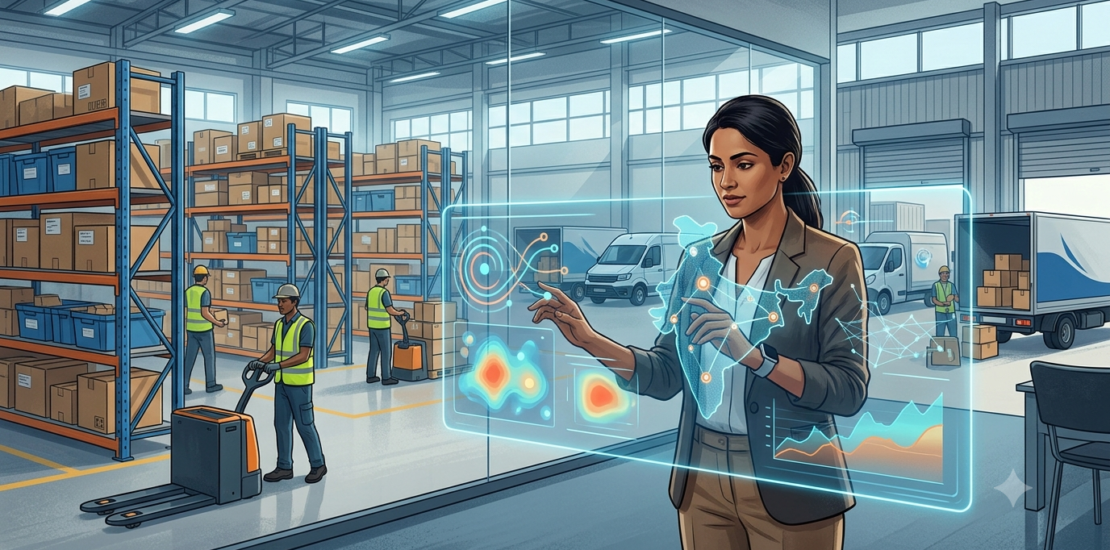
Supply Chain Management in E-commerce: The Complete Guide for 2026
Every online order sets off a chain of events: a supplier ships stock, a warehouse picks and packs it, a courier carries it across the city, and a returns team handles it if the customer changes their mind. Supply chain management (SCM) in e-commerce is the discipline that keeps all of this running on time and on budget.
This guide covers how it works, where it breaks, which technologies help, and why it is creating thousands of jobs in India.
What Is Supply Chain Management in E-commerce?
Supply chain management in e-commerce is the planning, coordination and control of everything between sourcing a product and delivering it to the customer, including returns. It covers:
- Sourcing and procurement: choosing suppliers and negotiating terms
- Inventory management: deciding what to stock, where and how much
- Warehousing and fulfilment: storing, picking, packing and dispatching
- Transportation and last-mile delivery: moving orders to the customer’s door
- Reverse logistics: handling returns, exchanges and refunds
- Information flow: keeping data visible across all of these stages
Traditional retail supply chains move bulk stock to stores. E-commerce supply chains move thousands of small, individual orders to scattered addresses, often with delivery promises measured in days or hours. That is why they are harder to run.
Why Supply Chain Management Matters for Online Businesses
It shapes the customer experience
Customers judge a store by what arrives and when. A wrong item, a damaged parcel, or a late delivery is remembered far longer than a good product page.
It controls your margins
Logistics is one of the largest cost lines in e-commerce. Dead stock, split shipments, failed deliveries and high return rates quietly eat profit.
It protects your brand and repeat sales
Reliable delivery builds trust, and trust drives repeat orders, which cost far less than acquiring new customers.
It decides whether you can scale
A process that works at 50 orders a day often collapses at 500. A well-designed supply chain lets you add products, cities, and sales channels without chaos.
The 6 Core Components of an E-commerce Supply Chain
1. Demand planning and forecasting
Forecasting uses past sales, seasonality, festivals, promotions and trends to predict demand. In India, events like Diwali, wedding season and end-of-season sales cause sharp spikes, so planning ahead is essential.
2. Inventory management
The goal is to hold enough stock to avoid lost sales without locking up cash in slow movers. Good practice includes:
- Real-time stock visibility across all warehouses and channels
- Safety stock levels set per SKU
- ABC analysis (prioritising high-value, fast-moving items)
- Regular clearance of ageing stock
3. Warehousing and order fulfilment
Speed and accuracy in the warehouse come from smart layouts, barcode or RFID scanning, clear bin locations and efficient pick-pack workflows. Many brands choose between running their own warehouse, using a third-party logistics (3PL) partner, or combining both.
4. Transportation and last-mile delivery
Last-mile delivery is usually the most expensive and least predictable leg. Key levers include courier partner mix, route optimisation, pincode-level serviceability and delivery-attempt rules.
5. Reverse logistics
Returns are a fact of online retail, especially in fashion, beauty and electronics. A clear return policy, quality checks and fast restocking turn returns from a pure cost into a recoverable one.
6. Data, tracking and communication
Order tracking, proactive delay alerts and accurate delivery estimates reduce support tickets and improve trust.
Biggest Supply Chain Challenges for E-commerce in India
| Challenge | Why it hurts | Practical fix |
|---|---|---|
| Fluctuating demand | Overstock or stockouts | Use sales data for forecasting; review weekly in peak season |
| High last-mile cost | Cuts margin on small orders | Compare couriers by pincode; set minimum order thresholds |
| Cash-on-delivery (COD) and RTO | Failed deliveries and returned shipments | Verify addresses, confirm COD orders by call/WhatsApp, nudge prepaid |
| Tier-2/3 delivery reach | Longer transit, patchy service | Use regional courier partners and distributed inventory |
| Returns | Reverse shipping and damaged goods | Better product content, size/shade guides, quality checks |
| System silos | Stock mismatches across channels | Integrate OMS, WMS and marketplace feeds |
| Supplier delays | Broken delivery promises | Backup suppliers and clear lead-time agreements |
Technology Transforming E-commerce Supply Chains
- Order and warehouse management systems (OMS/WMS): automate order routing, stock updates and picking
- AI and machine learning: improve demand forecasts and recommend reorder quantities
- Route optimisation software: reduces delivery time and fuel cost
- IoT and real-time tracking: gives visibility into shipments and temperature-sensitive goods
- Warehouse automation: conveyors, sorting systems and robotics speed up high-volume fulfilment
- Analytics dashboards: track metrics like order cycle time, on-time delivery and cost per order
Start with the problem, not the tool. A small seller often gains more from clean inventory data and a reliable courier mix than from expensive automation.
Key Metrics to Track
- Order fulfilment cycle time: order placed to order dispatched
- On-time delivery rate: share of orders delivered within the promised date
- Inventory turnover: how quickly stock sells through
- Stockout rate: how often items are unavailable
- Return rate and RTO rate: how many orders come back, and why
- Cost per order: total logistics cost divided by orders shipped
- Perfect order rate: orders delivered on time, complete, undamaged and correctly invoiced
Supply Chain Trends Shaping E-commerce
- Quick commerce: delivery in minutes pushes brands towards dark stores and hyperlocal inventory.
- Omnichannel fulfilment: buy online, pick up in store, and ship-from-store are becoming standard.
- Cold chain growth: food, pharma and health products need temperature-controlled logistics.
- Sustainable logistics: greener packaging, route efficiency and electric delivery fleets.
- Predictive analytics: moving from reacting to problems to preventing them.
- Transparency: shoppers increasingly expect live tracking and honest delivery estimates.
E-commerce Is Creating Supply Chain and Logistics Jobs in India
Every extra order creates work in warehouses, transport, planning and customer operations. As online shopping reaches smaller cities, hiring is expanding well beyond the metros.
In-demand roles include:
- Supply Chain Manager
- Logistics Manager
- Warehouse / Fulfilment Centre Manager
- Inventory and Demand Planner
- Procurement / Sourcing Manager
- Last-Mile Delivery Operations Manager
- Logistics and Supply Chain Analyst
- Returns and Reverse Logistics Executive
Skills employers look for: inventory and demand planning, Excel and data analysis, familiarity with WMS/ERP tools, vendor negotiation, and problem-solving under pressure.
Education paths: a BBA, B.Com or engineering degree, followed by specialised certifications or an MBA/PGDM in Logistics and Supply Chain Management.
7 Practical Ways to Improve Your E-commerce Supply Chain
- Clean your inventory data first. Every other improvement depends on accurate stock counts.
- Segment SKUs by sales velocity and margin, and manage them differently.
- Use more than one courier and route by pincode performance, not habit.
- Cut RTO with address validation, order confirmation and prepaid incentives.
- Set honest delivery promises. Under-promise and deliver on time rather than the reverse.
- Plan for peak season at least 6 to 8 weeks ahead.
- Review supplier performance monthly on lead time, defect rate and fill rate.
Frequently Asked Questions
Supply chain and logistics jobs are important in e-commerce because they ensure fast, accurate, and cost-effective delivery. These professionals manage inventory, warehouses, packaging, shipping, and customer returns — all of which directly impact customer satisfaction.
A strong supply chain helps e-commerce companies reduce delivery time, lower operational costs, improve order accuracy, and build customer trust. Efficient logistics gives brands a competitive advantage in the online marketplace.
Key logistics roles include warehouse managers, supply chain analysts, delivery coordinators, inventory managers, logistics supervisors, and last-mile delivery specialists. These roles ensure smooth operations from order placement to final delivery.
Technology improves supply chain and logistics by using automation, AI, real-time tracking, smart inventory systems, and data analytics. These tools help companies predict demand, manage stock, plan deliveries, and reduce errors.